Thursday, August 25, 2011

AMSFCC's intern in Juneau

Jaspri Sylvan worked with Dr. Ginny Eckert from the School of Fisheries and Ocean Sciences in her lab in Juneau. Learn more about her and her summer in the interview below!

Where did you grow up?

Juneau, Alaska

What is your educational background?

2010 Juneau Douglas High School Graduate and now a student of Brown University

Interests:

Growing up in Alaska got me interested in marine science. I have always been fascinated with marine life and I also really enjoy fishing and harvesting from nature. I have a great appreciation for the environment in which we live and share with so many different creatures. Conserving our environment is my greatest motivator for pursuing the marine sciences.

Career Goals:

My plans are to earn a bachelor degree in biology and a master’s degree in a more specialized area (presumably marine biology). From there I will pursue a career in which I can conduct research and seek ways in which we can live on this earth without decimating natural resources. However, I will keep my options open, and perhaps I will pursue a teaching job as well.

What are your primary responsibilities at your internship?

I am the primary caretaker of the wet lab that contains all of the live specimens. I make crab food, feed crab, clean the tanks, and make sure that the crab are overall content. There are a couple of on-going studies in the lab that I record data for. Together a graduate student and I take phytoplankton samples in Auke Bay. We analyze the samples to detect for Alexandrium (PSP causing dinoflagellate). I’ve also worked on a project studying the growth rate of juvenile king crab.

Favorite memory or what you like most about your internship

What I’ve liked most about my internship this summer is meeting so many experienced scientists. It’s great being part of a community actively learning and exploring interesting and important topics. There is such a wide variety of areas to explore. It’s been helpful witnessing what being and becoming a marine scientist entails. I know what to expect and I’m excited for it.

How has living on the coast and/or being an Alaska Native influenced your occupational choice?

Living in Southeast Alaska has had a huge impact on my interest in marine science, environmental studies, resource management and conservation. I grew up exploring the wilderness and following my curiosities with life of all sorts. I hope to one day have a career that allows me to stay in Alaska studying, and preserving its beauty.

What helped you get to where you are today and/or what roadblocks did you have to over come?

Relentless support and encouragement from my family, a good attitude, and eagerness to learn helped me get where I am today.

Any advice for young coastal Alaskan's who are interested in the marine sciences and fisheries?

My advice for those who are interested in the marine sciences is to volunteer! Get out there and meet local scientists and see if you can get some experience in their lab or help out with their research in any way. Start making connections and get your name out there.

AMSFCC funds three internships for coastal Alaskans

The Alaska Marine Science and Fisheries Career Coalition funded three interns this summer. Funds from the National Marine Fisheries Service to the Coalition were used to fund these interns – one with the Sitka Sound Science Center, another with Dr. Ginny Eckert from the School of Fisheries and Ocean Sciences at her lab in Juneau and the third working on marine mammals out of Kodiak with UAF researchers, Kate Wynne and Bree Witteveen. Check out the blogs to come to learn more about them, their career goals, and what they did this summer!

Friday, August 12, 2011

Crowley Maritime Corporation Scholarships!

Crowley Maritime Corporation is offering two $5,000 scholarships to students in the School of Fisheries and Ocean Sciences, with two more $5,000 scholarships for two students from the general student population at UAF. Preference will be given to Alaska Native students and students from communities that Crowley serves as the main marine fuel supply and distribution company. Awards will be announced September 2nd so apply quickly! Please contact UAF's Financial Aid Office for more information.


Wednesday, August 10, 2011

Bristol Bay Salmon Camp July 28th - August 2nd

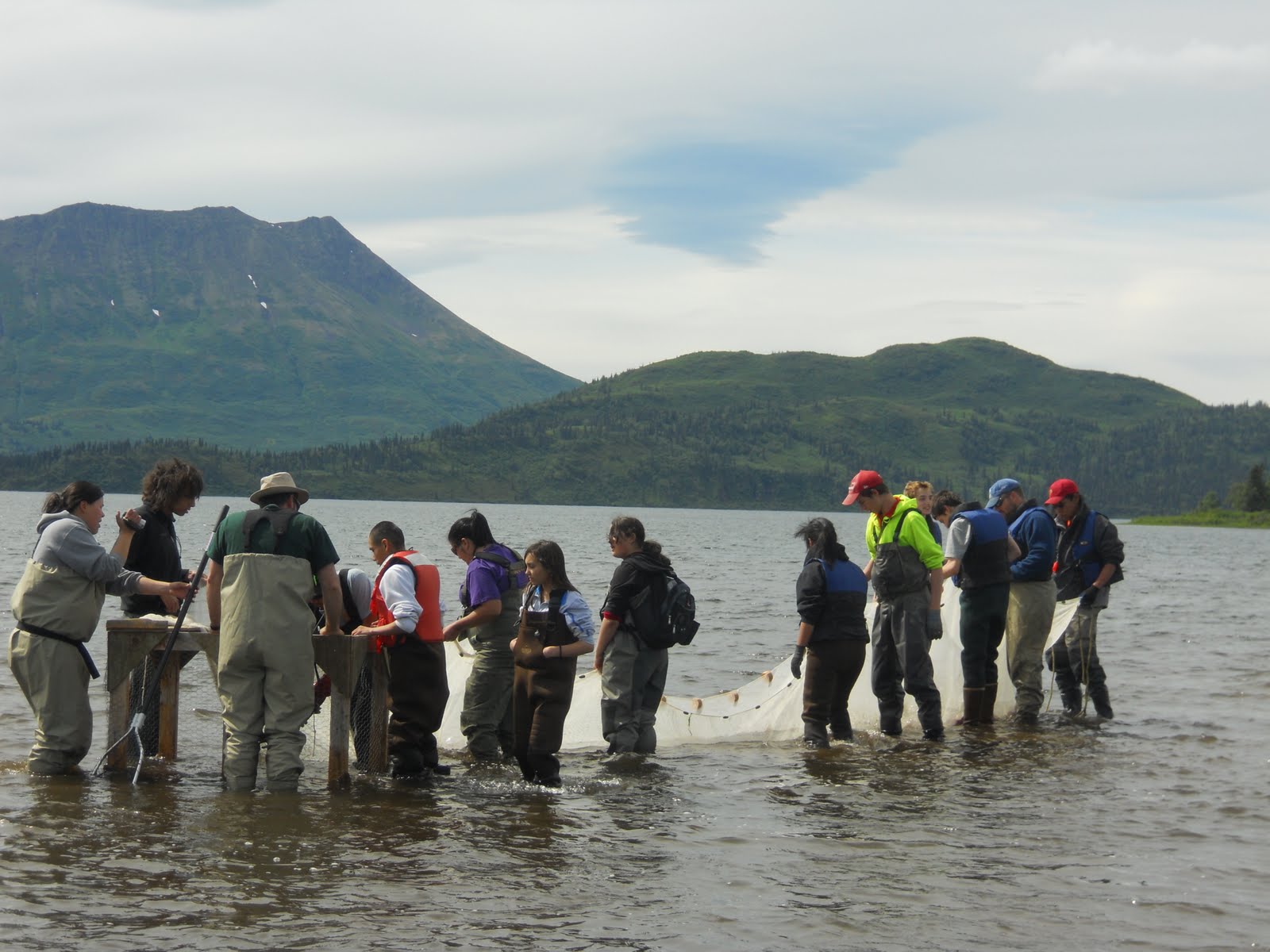
The Bristol Bay Economical Development Corporation (BBEDC) has offered a five day summer camp called Salmon Camp for a number of years however this year was a whole new adventure. In past years the camp has been open for only students in the Bristol Bay region however, this year, a grant from NOAA allowed the camp to expand and allowed six High School students around Alaska to join in on the fun. Eleven students total attended the camp and came from Scammon Bay, Fairbanks, Wrangle, Anchorage, Petersburg, Huslia, Twin Hills, Manokotak, Port Heiden, and Dillingham.

Salmon camp took place on Lake Aleknagik and included a variety of field activities. Skiffs were used as transportation to get us around to explore different creeks in the area. The students used seine nets and fishing poles to catch salmon and char to collect data on and dissect. They also collected data on the creek characteristics, macroinvertebrates, and water quality for the different creeks we visited. At the base camp the campers learned about renewable energy and charged batteries for lights and computers using solar panels, a windmill, and a bike. Groups of students were also challenged with a project they choose and also presented at BBEDC upon our return to Dillingham.

This camp was an awesome opportunity for the students to learn more about stream and salmon ecology, interact with new people, and explore an area that most of them had never been to before. We would like to say thanks to the counselors, Dr. Todd, our visitors from the Bristol Bay Campus, and Shawn from NOAA who all played a part in this awesome camp!

Monday, July 18, 2011

Fish Dissections!

Last week I had the opportunity to volunteer with the Middle School Academy held through ANSEP at the UAA campus. I joined the students on a day they were taking classes in genetics, ecology, hydrology, and dissection. I volunteered in the dissection lab and led three small groups through their exploration of a rainbow trout. Each kid had their own fish and we worked together to identify all the external and internal body parts of the fish. Some of the kids were really into the dissections, while others were not. However, they all participated and learned a lot. After the clean up, the students completed their dissection worksheets and were given the chance to check out some other previously dissected creatures.

To learn more about what ANSEP is all about and all the opportunities they offer check out their website!

Wednesday, June 22, 2011

2011 ADF&G Youth Days June 13 - 15th

The Alaska Department of Fish and Game held an outdoor youth days camp last week and the week before in Anchorage. These two camps lasted three days each and were open for kids ages 10-14. The camp is design to promote awareness and respect of Alaska’s natural resources and outdoor activities. The three days were filled with fishing, hunter safety, survival skills, map and compass education, wildlife ID and tracking, boating safety, ecology, and lots more.

I helped out during the second week to teach the kids about animal tracks, scat, watershed ecology, and a little fishing too. Thirty kids were divided into three groups and spent about an hour and a half in each area. On Monday we met at the Rabbit Creek shooting range and I worked with Elizabeth Manning. The kids first made plaster replicas of animal tracks. We also had a game that helped the kids learn how to identify scat and a relay to see how well they knew their tracks. We also had the kids break up into small groups and conduct a scavenger hunt while they made their way down to a crime scene. Earlier in the morning Elizabeth set up an area with feathers, tracks, and fake blood so that the kids could figure out what happened. The small groups were let in one at a time to scan the area and then were given a wanted list to help them figure out who died and who did it. After everyone had a look they all got to share what they thought had happened and they all had a variety of ideas. It was a lot of fun!

I joined the camp again on Wednesday when the kids were learning about identifying fish, looking at macroinvertebrates, learning salmon anatomy and life cycle, and learning how to fish. The longest activities were fly fishing and spin casting. The kids learned knots, how to cast, and once they were all setup with hooks got to go out and do some fishing at the lake. Although no fish were caught the kids had a blast and could have spent all day out there with their poles.

This camp was a great way to get the kids outside while learning about different aspects of science. Plus the kids all walked away with loads of information and even got a fishing pole so they continue to practice their safe fishing skills.

Thursday, June 16, 2011

2011 Making Waves Summer Camp!


The Sitka Sound Science Center offered a summer camp for grades 7 – 9 from May 31st till June 10th this year. This camp allowed students to explore marine biology, fisheries, and marine mammal science through fun, hands-on experiences. During the first week the kids learned basic laboratory skills, went kayaking, explored nearby beaches, and even got to snorkel with Coast Guard rescue swimmers.

A few days into the camp I joined in on the fun and worked with three wonderful counselors including one of the AMSFCC funded interns, Taylor. The second week included activities that ranged from combing beaches to cleaning whale bones. The kids caught fish for the center using a beach seine and enjoyed scooping up the fish, releasing the ones we couldn’t keep, and identifying them all. They learned about Humpbacks and scientific communication. They also had their own mini Ocean Science Bowl competition and even got to explore some little caves. They also got to play some games including a version of Marco polo to explore how echolocation works and a hatchery game that included water balloons.

Campers spent their last few days at camp participating in a few cultural activities and cleaning whale bones. The students were lucky enough to help out Dr. Shannon Atkinson in the process of starting to clean the bones of a juvenile male killer whale that washed up on a nearby beach in the spring. The kids worked on getting the ribs, skull, and vertebrae cleaned and did an amazing job even though they didn’t enjoy the smell. Work on the skeleton will continue during the next few months and once completed, the rearticulated skeleton will be on exhibit at the Sitka Sound Science Center.

The camp was loads of fun and got the attention of the whole community! You can find tons of pictures from the camp in our photos and on the Sitka Sound Science Center’s Facebook page. Also listen to a cool broadcast about the orca skeleton that was aired on Raven Radio.

Before and after of one set of vertebrae that were cleaned.